
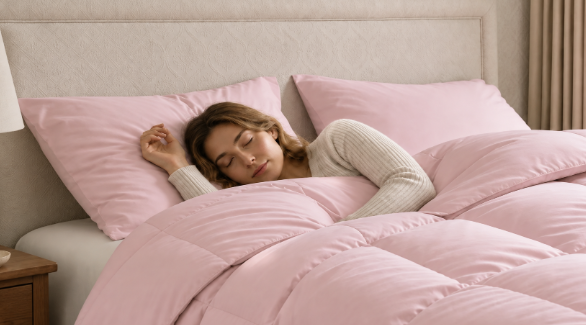
For most sleepers, goose down is the better comforter fill: it gives the most warmth for the least weight, breathes well, and keeps its loft for many years with reasonable care. Wool is the better choice for people who want a heavier, closer-draping cover or who have a confirmed down allergy. Silk fill suits mild climates and people who dislike loft, and synthetic fill is the budget, easy-wash option that tends to flatten sooner.
That is the short version. The longer version depends on how you sleep, what your bedroom is like, and one naming problem that trips up a lot of shoppers.
First, a naming problem: silk fill or silk shell?
“Silk comforter” can mean two quite different things. Sometimes it means a comforter filled with silk floss, the long fibres drawn from silkworm cocoons. Sometimes it means a down comforter whose outer fabric contains silk. The two feel and perform very differently, and product listings do not always make the distinction obvious.
The Warmy Tummy Deluxe Silk Goose Down Comforter belongs to the second group. It is an 800 fill power European down comforter in which the silk sits in the shell, blended with Egyptian cotton, while the insulation is goose down. So when comparing fills, keep the fill and the fabric apart in your head. The fill decides warmth and weight; the shell decides how the comforter feels against the skin and how quickly it lets moisture out.
With that settled, here is how the four common fills compare.
Goose down
Down is the soft undercoat beneath a bird’s outer feathers. It traps air in three dimensions, which is why it insulates so well for its weight. Its quality is usually described by fill power: the volume, in cubic inches, that one ounce of down occupies when fully lofted. Higher fill power means larger clusters that trap more air per ounce, so less down is needed for the same warmth.
Strengths: the best warmth-to-weight ratio of any common fill, good breathability, excellent recovery after compression, and a long working life when it is dried properly and not crushed in storage.
Weaknesses: it needs patient drying after washing, because damp down clumps. People with a diagnosed down allergy should avoid it. And the sourcing of down raises fair animal welfare questions, which is what the Responsible Down Standard (RDS) was created to address.
Wool
Wool fill is made from carded sheep’s wool, usually batted into layers. It behaves very differently from down.
Strengths: wool handles moisture well and has a reputation for keeping sleepers comfortable across a range of temperatures. It drapes close to the body, which some people find calming. It is also a natural alternative for those who cannot use down.
Weaknesses: for the same warmth, wool is noticeably heavier and has far less loft. Many wool comforters need specialist cleaning or careful hand-washing, and wool can compact over time.
So, goose down or wool? If you want lightness and loft, down. If you want weight and drape, or cannot sleep with down, wool.
Silk fill
Silk-filled comforters use long silk floss stretched into layers.
Strengths: very light, smooth, and close-draping, with a gentle, even warmth that suits mild climates and people who dislike a puffy bed.
Weaknesses: little loft, so limited warmth on cold nights unless the comforter is very heavily filled. Care instructions are often restrictive.
Synthetic fill
Synthetic fills are usually polyester fibres or clusters designed to imitate down.
Strengths: lowest cost, easy machine washing and drying, and no animal-derived material, which suits people with allergies or ethical objections to down.
Weaknesses: synthetic fills generally hold more heat and moisture than down at similar warmth, so they can feel clammy. They also tend to lose loft sooner, which shortens their useful life.
Where a silk shell over down fits
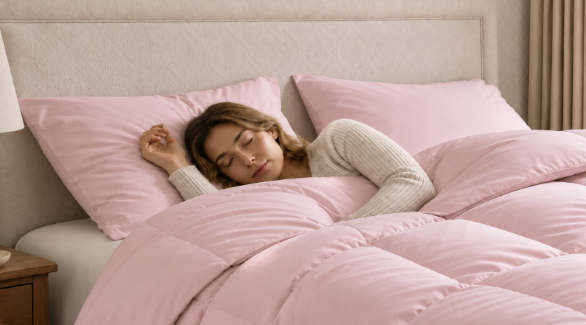
A silk-blend shell over goose down tries to combine the strengths of two materials: the warmth-to-weight of high-fill-power down, and the smooth, moisture-wicking surface that people like about silk. It does not turn down into silk fill. It changes what you touch.
The specs, in plain terms
The Warmy Tummy Deluxe Silk Goose Down Comforter pairs a shell of 80% Egyptian cotton and 20% silk with a satin finish, woven in Japan at 600 thread count, with a fill of 90% European goose down at 800 fill power, held in a baffle box with Air-CircuX(TM) airflow channels and anchored by corner loops, certified to the Responsible Down Standard (RDS), OEKO-TEX(R) STANDARD 100 and IDFL, and offered in Light, All Season and Ultra Warm across three sizes — Twin/Twin XL 68″x86″, Full/Queen 90″x90″ and King/Cal King 107″x90″.
Read against the fill comparison above, the 800 fill power figure is what places it firmly in the down camp: lofty clusters, high warmth for their weight. The silk shows up in the shell and in the feel, not in the insulation. The three warmth levels matter too, because fill power alone does not tell you how warm a comforter is; the amount of down does.
How to choose between the four
Start with your own sleep, not with the material.
- You sleep cold, or your bedroom is cool: down, in a warmer weight. It delivers warmth without the pressure of a heavy cover.
- You sleep hot or sweat at night: down in a Light weight with a breathable shell, or wool if you prefer weight. Avoid dense synthetic fills.
- You love the feeling of weight: wool. Down, even in Ultra Warm, will never feel heavy in the same way.
- You have a confirmed down allergy or object to animal materials: wool, silk or synthetic, depending on the above.
- You want the lowest cost and easiest care: synthetic, accepting a shorter lifespan.
If down is the answer but a silk-blend shell is more than you want, a down-and-feather organic cotton comforter is the more everyday route, with a fill of 90% goose down and 10% goose feather inside a cotton sateen shell.
The honest trade-offs
No fill wins on every count. Down asks for more care when drying and more attention to sourcing, which is why named certifications matter: the Responsible Down Standard (RDS) for welfare and traceability, OEKO-TEX® STANDARD 100 for harmful substances in the finished textile, and IDFL for independent down and feather testing. Wool asks you to accept weight. Silk fill asks you to accept limited warmth. Synthetic asks you to replace it sooner.
A silk-shell down comforter adds its own trade-off: it will not suit anyone who wants a heavy, close drape, and anyone who prefers a drier, more textured hand may be happier with a linen-blend shell. If you want to see the whole spread of shells and weights before settling, the brand’s current down comforter lineup lays them out in one place.
FAQ
What is better for a comforter, goose down or wool? Goose down is better for most people, because it gives more warmth for less weight and keeps its loft longer with proper care. Wool is better if you want a heavier, closer-draping cover, sleep in a humid room, or have a confirmed down allergy. For hot sleepers, a Light-weight down comforter with a breathable shell is often the best of both.
Is a silk comforter filled with silk? Not always: a silk comforter can be filled with silk floss, or it can be a down comforter with a silk-blend shell. Silk-filled comforters are light and close-draping but have little loft. Silk-shell down comforters keep the warmth of down and add a smooth, moisture-wicking surface. Check the fill line on the product description before buying.
Is an 800 fill power down comforter too warm? No, 800 fill power by itself does not make a down comforter too warm, because fill power measures the quality of the down, not the amount. Warmth depends mainly on how much down is inside, which is what warmth levels such as Light, All Season and Ultra Warm describe. A Light 800 fill power comforter can suit warm sleepers well.