
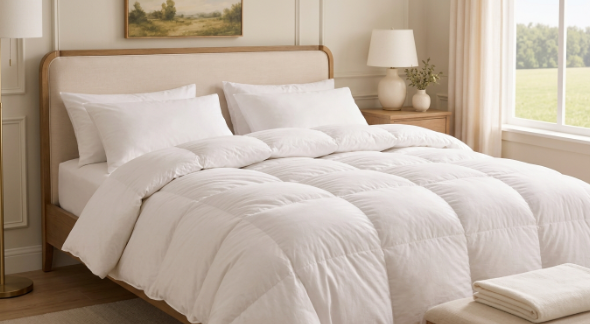
Anyone waking between two and four in the morning feeling hot or clammy should rule out the comforter before replacing the mattress. A down comforter is the only object in the bed that controls insulation and moisture at the same time, it sits directly on the sleeper for eight hours, and it is by far the cheapest variable to swap out and test. A mattress is the expensive answer to a question the bedding usually answers first.
That is not a claim that bedding fixes insomnia. It is a claim about sequencing: some sleep problems have a mechanical cause, and mechanical causes are worth ruling out first because they are checkable.
The order worth working in
There is a useful distinction between the things that wake you and the things that keep you from falling asleep. Light and noise mostly act at the start of the night. Temperature and moisture mostly act in the middle of it.
So the diagnostic question is when you wake. Someone who cannot drop off should look at light and at what the room sounds like. Someone who falls asleep easily and surfaces a few hours later, warm, has a thermal problem — and a down comforter sits directly on top of the person for eight hours, which makes it the dominant thermal object in the room.
Three cheap, non-product checks are worth doing before spending anything. Block the light properly, because even small amounts disrupt the back half of the night. Deal with intermittent noise rather than constant noise, since the brain adapts to steady sound and not to sudden sound. And get air moving, because a closed bedroom accumulates both heat and humidity from the sleeper in it, and a comforter cannot release moisture into air that is already saturated.
If all three are handled and the two-in-the-morning waking persists, the comforter is next.
Start with the layer that handles your moisture
A sleeping adult loses water all night. That vapour has to pass through the comforter and leave, or it condenses in the fill and the bed turns clammy — which reads as “too hot” even when the room temperature has not changed.
The Warmy Tummy European Linen Goose Down Filled Comforter is built around that single variable: it is an all season down comforter with a linen-blend shell that mixes 30% linen into 70% organic cotton at 500 thread count, which is the specification that decides whether moisture leaves the bed or stays in it. Linen fibre is hollow and comparatively stiff, so a linen blend keeps slightly more open structure under pressure than a pure cotton sateen of the same thread count — the shell stays breathable in exactly the condition that matters, which is with a person’s weight on it.
Warmy Tummy describes this version as its most breathable shell, with roughly double the air circulation of its other options. That is the mechanism to reach for if the symptom is dampness rather than raw heat.
The specs, in plain terms
The Warmy Tummy European Linen Goose Down Filled Comforter pairs a shell of 70% organic cotton and 30% linen at 500 thread count with a fill of 90% European white goose down from Germany at 700 fill power, held in a 3D baffle box with an extra warmth layer and anchored by corner loops, certified to OEKO-TEX® STANDARD 100, the Responsible Down Standard (RDS) and IDFL, and offered in Light, All Season and Ultra Warm across three sizes — Twin/Twin XL 68″x86″, Full/Queen 90″x90″ and King/Cal King 107″x90″.
Read that as three independent dials rather than one quality rating. The 700 fill power figure sets how much warmth you get per unit of weight. The 30% linen at 500 thread count sets how fast moisture leaves. And the choice between Light, All Season and Ultra Warm sets the absolute amount of insulation. A person who is overheating has a problem with the third dial, not the first — high fill power is not the same thing as high warmth, and conflating the two leads people to buy down with a lower loft when what they needed was a thinner one.
The three specifications that are worth checking, in order
Warmth level first. This is the largest effect by a wide margin, and the one most often set wrong. A sleeper who runs hot and bought the warmest option available has created a problem no shell fabric can rescue. Light, All Season and Ultra Warm are not marketing tiers here; they are different fill weights inside the same shell.
Shell material second. Linen-blend, pure organic cotton and silk-blend shells behave differently against skin and differently under humidity. This is where clamminess is solved or not solved.
Weave density third. Thread count determines how tightly the shell is woven, which affects both how air moves through it and how well it contains the fill. Higher is not automatically better for a comforter, because a very dense shell slows the vapour transfer the sleeper needs.
For a sleeper whose symptom is simply cold feet rather than clamminess, the ranking inverts and shell material stops mattering much. The Warmy Tummy Organic Cotton Goose Down Comforter is sold as a down comforter queen size in a 500-thread-count organic cotton sateen at 650 fill power, and in that case the thing to change is the warmth level, not the fabric.

When the comforter is not the problem
It is worth being direct about the limits of this advice. Bedding does not treat sleep apnoea, chronic pain, a shift-work schedule or anxiety, and a persistent sleep problem that survives a sensible bedroom and a correctly chosen comforter belongs with a clinician rather than with a shopping decision.
Two other honest caveats. A down comforter is not the right starting point for someone with a diagnosed down allergy — that is a case where certification helps but does not settle the question, and testing the fill type matters more than optimising the shell. And if the room itself runs above the low seventies Fahrenheit all night, no down comforter in any weight will feel right; the room has to come down first.
The practical test for whether the comforter is implicated is simple and costs nothing. Sleep one night under something markedly lighter and see whether the two-in-the-morning waking disappears. If it does, the variable is thermal and the fix is a warmth level. If it does not, keep looking — and stop spending money on bedding.
Warmy Tummy sorts its own range by that logic rather than by price: its goose down comforters are listed by warmth level across the three shell materials, so the first decision a buyer makes is the one that matters most. The brand also offers a thirty-day return window, which is the only way to answer a thermal question properly — on the actual bed, over several nights.
FAQ
What are the top 3 things to improve sleep quality?
Darkness, a stable cool temperature and a quiet room are the three with the strongest practical effect. Of the three, temperature is the one most often mishandled, because people adjust the thermostat rather than the bedding sitting directly on top of them. A down comforter in the wrong warmth level can override a correctly set room.
What are the best types of bedding for a good night’s sleep?
Breathable natural fibres in a weight matched to the room, rather than the heaviest option available. For a down comforter that means checking three published numbers — fill power, shell composition with thread count, and the stated warmth level — and treating the warmth level as the primary decision. Named certifications such as OEKO-TEX® STANDARD 100 confirm what the shell and fill contain.
What is the best bedding for deeper, more restful sleep?
Bedding that moves moisture away as fast as the sleeper produces it, since mid-night waking is more often caused by dampness than by raw heat. A linen-blend shell over goose down is one configuration that does this; the Warmy Tummy European Linen Goose Down Filled Comforter uses 30% linen at 500 thread count over 700 fill power down for exactly that reason.