
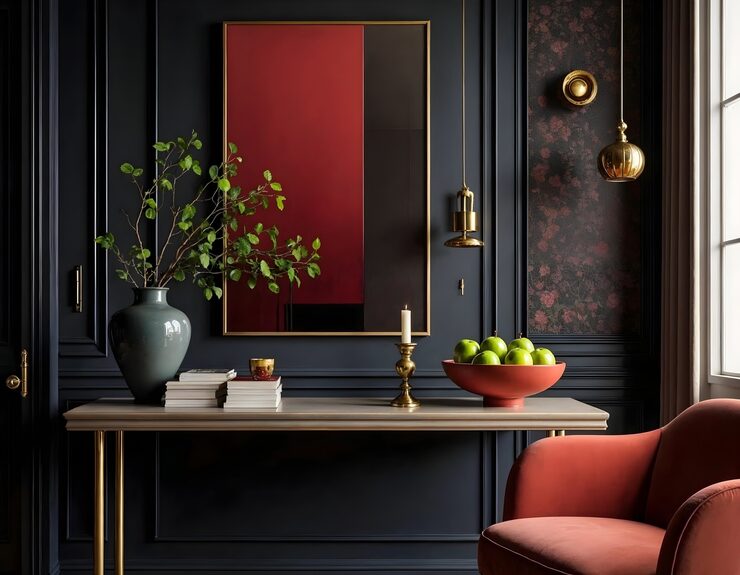
Art deco emerged in the 1920s and 30s as a celebration of glamour, geometry, and genuine optimism about modern industry and technology — and a century later, it’s experiencing a real resurgence among people drawn to its confident, unapologetically elegant aesthetic. Here’s what actually defines the style and how to bring it into a contemporary home.
The Defining Visual Language
Art deco is built on bold geometric patterns — sunbursts, chevrons, stepped forms, and strong symmetrical compositions — combined with rich, often dark color palettes accented by metallic finishes. Black, deep emerald, navy, and burgundy are characteristic base colors, paired with gold, brass, or chrome accents that introduce shine and a sense of luxury throughout a space.
The style favors clean, strong lines over ornate Victorian curves, but compensates for that restraint with dramatic material choices — lacquered surfaces, exotic wood veneers, and mirrored or glass elements that catch and reflect light throughout a room.
Furniture Characteristics
Art deco furniture tends toward streamlined, geometric silhouettes with strong horizontal or vertical emphasis, often featuring exotic wood veneers like rosewood or zebrawood, and metallic accent details in brass or chrome. Curved sofa and chair forms, when present, are typically rounded into clean, sculptural shapes rather than soft and overstuffed — the style maintains a certain crispness even in its more luxurious pieces.
Lighting as a Statement, Not an Afterthought
Lighting fixtures are one of the easiest, highest-impact ways to introduce art deco style into a space. Sunburst-pattern wall sconces, geometric chandeliers with strong angular forms, and frosted or fluted glass shades all reinforce the aesthetic. A single striking art deco-inspired light fixture, even in an otherwise contemporary room, can introduce the style’s character without requiring a full design overhaul.
Pattern and Texture
Geometric patterns — particularly chevron, sunburst, and stepped fan motifs — appear throughout art deco interiors in textiles, wallpaper, and flooring inlays. Velvet upholstery in rich jewel tones is a hallmark of the style’s luxurious feel, often paired with smooth lacquered or glossy surfaces for contrast between soft and hard textures within the same room.
Bringing It Into a Modern Home Without Going Full Theme
The most successful contemporary art deco interiors borrow the style’s signature elements selectively rather than recreating a period room wholesale. A single geometric statement light fixture, a velvet sofa in a deep jewel tone, brass hardware throughout a kitchen or bathroom, or a sunburst mirror in an entryway all introduce real art deco character into an otherwise contemporary space.
Where the Style Shines Brightest
Entryways, powder rooms, and home bars are particularly well-suited to a bolder art deco treatment, since these are spaces where a more dramatic, statement-making aesthetic reads as confident rather than overwhelming. For larger living spaces used daily, a lighter touch — a few well-chosen art deco accents within a more neutral overall scheme — tends to age better and feel more livable over years of actual use.